Introduction
We were brought in to work on a high-traffic cricket betting site that publishes live scores, odds, and match predictions. The content team was doing everything right. They created fresh prediction pages for every fixture, tips pages for each tournament, and schedule pages for the IPL, PSL, WPL, BBL, The Ashes, and more. On paper, the site should have been ranking. In reality, a large share of those pages were either not indexed at all, indexed with the wrong signals, or dropping out of the index because Google was wasting its crawl budget on the wrong URLs.
The whole niche is time-sensitive. A prediction page for a match tomorrow is worth a lot today and almost nothing a week later. That makes crawl budget, indexing speed, and clean technical signals far more important here than on a typical content site. Google has to discover and crawl each page fast, while it still ranks, and every wasted crawl is a prediction page that never got its shot.
Story
We started, as always, with Google Search Console and a full crawl, comparing what Googlebot could actually reach against what was indexed. Two problems stood out right away.
First, the site was leaking crawl budget in every direction. It kept two full years of match and prediction pages live before applying noindex, so Googlebot was spending its time re-crawling thousands of dead 2024 fixtures instead of this week’s matches. On top of that, category pages used a “Show More” button instead of real pagination. Googlebot does not click, so every fixture behind that button had no internal links pointing to it and was effectively invisible to search.
Second, the pages Google did crawl were sending mixed or broken signals. Old matches carried two robots meta tags in the source at once, handing Google contradictory index and noindex instructions. On the homepage, the title, meta description, and Open Graph tags were rendering right before the closing body tag instead of inside the head, so crawlers and social bots were not reliably reading them. The news sitemap listed every article ever published instead of the last 48 hours, breaking Google News eligibility. A second sitemap was not even referenced from the sitemap index, and match URLs marked noindex were still sitting inside the XML sitemap, contradicting their own tags.
Individually, none of these were exotic. Together, they meant the site’s best, most timely content was competing with one hand tied behind its back.
Challenge
The core challenge was that the issues were spread across crawling, indexing, rendering, and content signals all at once, and several of them were silently costing rankings without any obvious error in the browser.
- A headless, JavaScript-rendered front end. Match and prediction data loaded from a separate API, so we had to verify how each page rendered for Googlebot rather than trusting how it looked in a browser. This is the same class of problem that hides real indexing issues from manual testing.
- Wasted crawl budget on expired content. Two years of stale fixtures, “Show More” pagination, and hidden internal links inside collapsed Tables of Contents were all pulling Googlebot away from the fresh, rankable pages.
- Contradictory indexing signals. Duplicate robots meta tags,
noindex URLs left in the sitemap, an orphaned sitemap, and a news sitemap that broke Google News rules were sending Google conflicting instructions about what to index. - Lost ranking equity from broken redirects. Redirect chains were stripping tournament slugs (for example
/ipl/, /psl/, /wpl/, /the-ashes/) and dumping all that traffic, plus high-authority backlinks with exact-match anchors like “IPL 2024 odds,” onto a single generic schedule page. - Slow indexing of time-sensitive pages. The site relied on passive crawling, so prediction pages often were not indexed until well after the match they targeted, when the search intent had already passed.
- Google’s new 2MB crawl limit. Google reduced the uncompressed HTML it downloads per page from 15MB to 2MB. Around seven heavy pages exceeded that threshold, so their content risked being truncated and never fully indexed.
- Missing pages from data gaps. Two back-end sync jobs were failing silently, so entire tournaments and venues never got pages created for them at all, leaving obvious keyword opportunities uncovered.
Solution
We worked in priority order: first stop the crawl-budget bleed, then clean up indexing signals, then speed up indexing of new pages, and finally strengthen the on-page and internal-linking layer.
Crawl budget optimization
- Built an automated archiving system. Match and prediction pages older than one month are moved to an
/archive/ directory, the original URLs 301-redirect to the new location, and /archive/ is blocked in robots.txt. This preserves user access and backlink equity while stopping Google from wasting crawl budget on expired fixtures. - Replaced the “Show More” button on category pages with standard numbered pagination (1, 2, 3 and so on) so crawlers can discover and index every subpage.
- Expanded the Tables of Contents by removing the accordions, exposing the internal links inside them so Google can crawl and understand the page structure.
- Restricted the news sitemap to a rolling 48-hour window in line with Google News guidelines, so it only surfaces genuinely fresh articles.
Indexing signals cleanup
- Removed the duplicate, contradictory robots meta tags on old content so Google receives one clear signal per page.
- Removed
noindex match URLs from the XML sitemap and referenced the previously orphaned sitemap from the sitemap index, resolving the conflicts between sitemap inclusion and page-level directives. - Moved the homepage SEO meta tags (title, description, Open Graph) out of the body and back into the head, where crawlers and social platforms actually read them.
- Fixed the
article:modified_time meta tag to update dynamically, so Google stopped showing a stale “last updated” date in the SERP snippet even though the content refreshed daily.
Faster indexing of time-sensitive pages
- Integrated the Google Indexing API so the site proactively pings Google the moment a prediction or schedule page is added or updated, instead of waiting for a passive sitemap sweep. Time-sensitive pages now get crawled within minutes rather than days.
- Automated the schedule table and supporting content on schedule pages so the internal links to match-prediction pages exist the instant the page is created, giving Googlebot something to crawl and follow immediately.
- Fixed the broken redirect chains so each tournament slug resolves to its intended page, reconnecting high-authority backlinks and their exact-match anchors to the content they were meant to support.
On-page & Core Web Vitals
- Optimized the roughly seven oversized pages to bring uncompressed HTML under Google’s new 2MB crawl limit, so their full content stays crawlable and indexable.
- Installed and configured automated keyword-based internal linking to the money pages, giving consistent, scalable link distribution to the pages that drive revenue.
- Added month and year shortcodes so dates on evergreen pages stay current automatically, keeping content fresh without manual edits.
- Reduced page weight by stripping unused live-scorecard code and consolidating it into a lighter match-info section, improving load performance on the highest-traffic pages.
- Fixed the back-end sync gaps so every tournament and venue reliably generates its own page, closing the content and keyword coverage holes.
Result
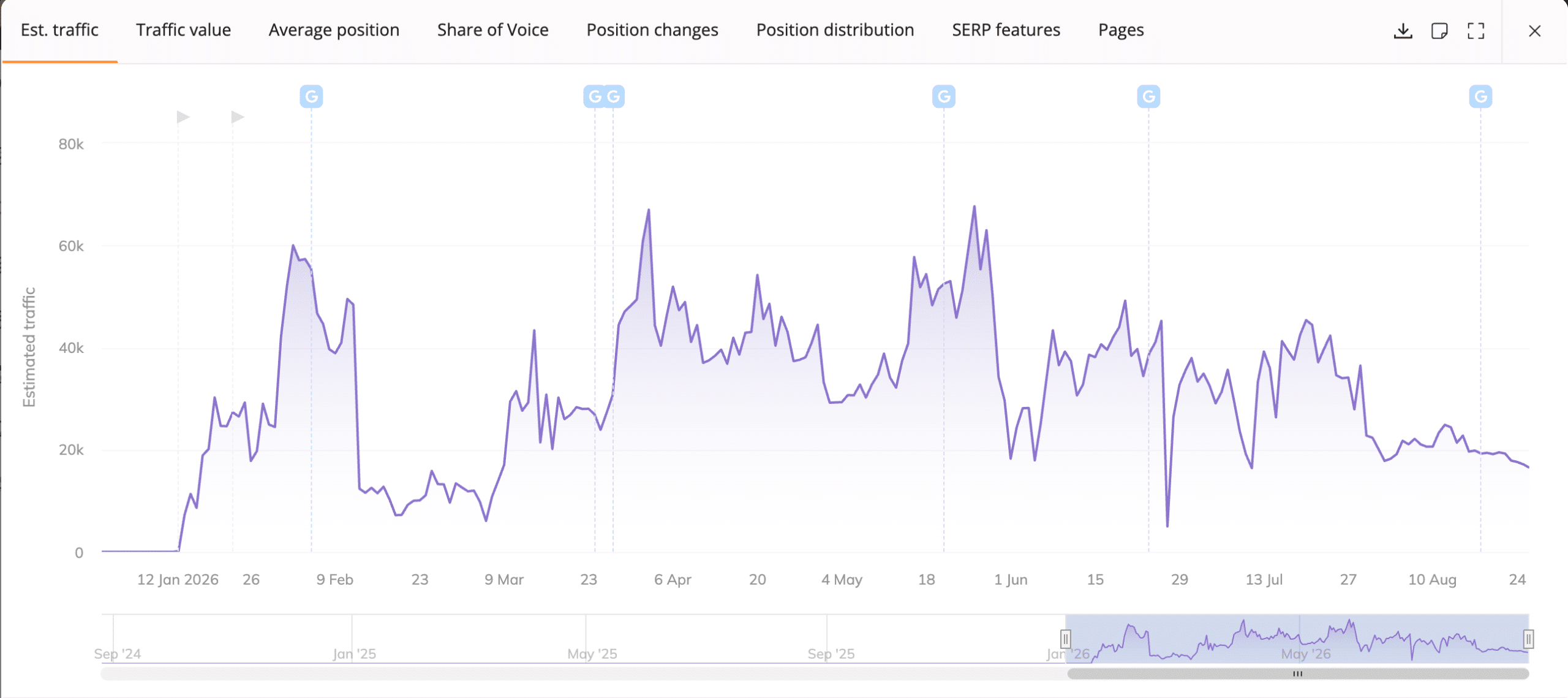
The technical foundation went from working against the content team to amplifying it, and the traffic curve shows it.
Because this is a cricket betting and predictions site, organic traffic tracks the match calendar rather than climbing in a straight line. During the busy tournament windows in April and late May the site peaked at roughly 65,000 to 68,000 estimated organic visitors, with an earlier peak near 60,000, and even in quieter, off-season weeks it has held a baseline of around 15,000 to 30,000 estimated organic visitors. Ten months in, the work is ongoing and the site continues to move with the season.
What drove it:
- Time-sensitive prediction and schedule pages started getting indexed within minutes of publishing instead of days, thanks to the Google Indexing API and the automated internal linking on freshly created schedule pages. In this niche, that is the difference between ranking while a match still matters and ranking after the intent has passed.
- Crawl budget stopped being spent on two years of dead fixtures and got redirected to the pages that matter this week. The archive system, real pagination, expanded ToCs, and the sitemap cleanup together pointed Googlebot at the right URLs.
- The indexing signals became consistent. Removing duplicate robots tags, cleaning the sitemaps, and moving the homepage meta tags back into the head meant Google finally received one clear, correct instruction per page instead of contradictory ones.
- The tournament-slug redirect fix reconnected high-authority backlinks to their intended pages, recovering ranking power that had been silently draining into a generic schedule page.
- Closing the back-end data gaps meant entire tournaments and venues that previously had no pages now compete for their own keywords.
The pattern here is one we see over and over. The content and the search intent were already right, but the technical layer of crawl budget, indexing signals, and speed of indexing was quietly capping everything the business was investing in content. Fix the foundation, and the pages the team is already producing finally get to rank.
ROI
The site monetizes through betting operator referrals and affiliate revenue, and organic search is the primary channel driving it. Visibility during live tournaments converts directly into signups and deposits, so the technical work translates straight into revenue.
At the traffic levels above, this organic visibility drives approximately €20,000 per week in revenue, or roughly €86,700 per month.
Against that, the client’s monthly investment in this work is:
- €4,000 per month for ongoing technical SEO
- $5,000 per month for backlink and off-page budget
That is a combined spend of a little over €8,000 per month returning around €86,700 per month in organic revenue. In other words, every euro invested is returning roughly ten, and the technical foundation that makes it possible is now maintained and improved month over month as new fixtures, tournaments, and seasons roll through.
The engagement has been running for 10 months and is still ongoing.