Understanding the specific mechanism by which each failure causes ranking loss explains why prevention — not post-migration recovery — is the correct investment.
Redirect chains occur when old URLs redirect through one or more intermediate URLs before reaching their final destination on the new platform. Each hop in a redirect chain reduces the link authority transferred by approximately 15% — meaning a two-hop chain passes roughly 72% of the original link equity, and a three-hop chain passes approximately 61%. For a site with 2,000 pages and an average of 40 backlinks per priority page, redirect chain proliferation produces a compounding domain-wide authority loss that suppresses rankings across the full page set rather than isolating the impact to individual URLs.
Canonical tag misconfiguration is the most common and least visible migration failure. Enterprise CMS platforms — SAP Commerce Cloud, Adobe Experience Manager, Salesforce Commerce Cloud — generate canonical tags based on configurable URL patterns. A misconfigured canonical tag rule that points every product page to the homepage, or every category page to a paginated variant, instructs Google to treat thousands of priority pages as duplicates of a single low-value URL — collapsing rankings across entire page categories simultaneously.
Meta data loss occurs when CMS migration tools transfer content fields but not SEO-specific meta fields. Title tags default to page titles, meta descriptions are left empty, structured data markup is absent, and hreflang tags are dropped entirely for international variants. Pages stripped of their meta data in migration lose the on-page signals that contributed to their rankings — and recover those signals only after the meta data is manually reconstructed and Google re-crawls and re-evaluates each affected page.
Core Web Vitals regressions introduced during migration suppress rankings in competitive results immediately after launch. A site migrating from a lightweight custom CMS to WordPress with a feature-rich theme may see Largest Contentful Paint increase from 1.8 seconds to 4.5 seconds due to unoptimized image formats, render-blocking JavaScript from theme assets, and third-party scripts added by the new platform. Google’s ranking systems treat Core Web Vitals thresholds as competitive filters — pages scoring Poor are ranked below Good-scoring equivalents with otherwise equivalent content and backlink profiles.

SEO Domain Migration — €399 Covers domain-only migrations for sites up to 500 indexed pages where the URL structure, CMS, and content remain unchanged — only the domain name changes. Delivers pre-migration SEO baseline audit, complete one-to-one redirect mapping from old domain URLs to new domain URLs with no chains or homepage catch-alls, Google Search Console Change of Address notification, backlink update outreach for the 20 highest-authority referring domains, and post-migration technical verification audit within 7 days of launch. Includes 30-day ranking and traffic monitoring post-launch.
Recommended for: rebranding migrations, ccTLD to .com migrations, domain acquisitions where the new domain replaces an existing one, and business restructures requiring a domain change without platform or URL structure changes.
SEO Site Migration — €799 Covers CMS platform migrations, URL restructuring migrations, site redesigns involving URL or structure changes, and HTTPS migrations for sites between 500 and 5,000 indexed pages. Delivers pre-migration baseline audit across all indexed URLs and keyword positions, full URL mapping table with one-to-one redirect specifications, meta data and structured data transfer specification, XML sitemap and robots.txt configuration for the new platform, Core Web Vitals baseline and post-migration performance comparison, post-migration technical verification audit within 7 days of launch, and 45-day ranking and traffic monitoring. All issues identified during the monitoring period are remediated within scope at no additional cost.
Recommended for: WordPress to Webflow migrations, Magento to Shopify migrations, custom platform to WordPress migrations, URL restructuring as part of a site redesign, and HTTPS migrations on mid-scale sites.
SEO Enterprise Site Migration — €4,999 Covers enterprise platform migrations involving 5,000+ indexed pages, simultaneous multi-change migrations (domain change + CMS change + URL restructure combined), domain consolidations following mergers and acquisitions involving two or more source domains, and international migrations requiring hreflang reconfiguration across 5+ language-country variants. Delivers pre-migration enterprise SEO audit and full baseline establishment, migration architecture planning across URL structure, international hreflang, crawl budget, and redirect mapping layers, staged implementation with pre-launch verification at each phase, Google Search Console configuration and indexation acceleration immediately post-launch, and 60-day post-migration monitoring with 24-hour intervention on identified failures. All issues identified during the 60-day monitoring period are remediated within scope.
Recommended for: SAP Commerce Cloud, Adobe Experience Manager, Salesforce Commerce Cloud, and custom enterprise platform migrations; post-merger domain consolidations; international site migrations with multi-language hreflang complexity; and any migration involving simultaneous changes across domain, platform, URL architecture, and international configuration.

Phase 1 — Pre-migration baseline audit Before any migration work begins, we establish the complete SEO baseline: every indexed URL and its current keyword ranking positions, every internal link and anchor text, every meta data element including title tags, meta descriptions, canonical tags, structured data markup, and hreflang configuration, and the complete backlink profile mapped to specific URLs. This baseline serves as the benchmark for post-migration performance measurement and the source document for redirect mapping, meta data transfer, and technical specifications.
Phase 2 — Migration architecture planning We plan every technical architecture decision before implementation begins — URL structure mapping, redirect mapping table covering every indexed URL, canonical tag configuration rules for the new platform, XML sitemap structure, robots.txt directives, and for enterprise migrations, international hreflang architecture and crawl budget allocation strategy. Architecture decisions made incorrectly at this phase affect every page simultaneously — we eliminate ambiguity before a single redirect is implemented.
Phase 3 — Implementation specification delivery Every technical specification is delivered in implementation-ready format — redirect mapping tables in CSV format ready for server configuration, canonical tag rules specified as CMS configuration instructions, structured data markup blocks ready for template insertion, XML sitemap specifications ready for submission — so your development team can execute without back-and-forth clarification or additional scoping.
Phase 4 — Pre-launch verification Before the new platform goes live, we verify redirect mapping accuracy across all source URLs via automated crawl, canonical tag configuration across every migrated page category, hreflang implementation for every language-country pair on international sites, XML sitemap accuracy with no references to old platform URLs, robots.txt configuration with no priority page categories accidentally blocked, and Core Web Vitals scores on the new platform against the pre-migration baseline.
Phase 5 — Post-launch monitoring and remediation We monitor keyword ranking positions and organic traffic daily for 30–60 days post-launch depending on service tier, comparing against the pre-migration baseline by page category. Post-migration ranking fluctuation is normal for 2–6 weeks as Google re-crawls and re-evaluates the full page set — we distinguish between expected temporary movement and genuine technical failures, and act on identified failures within 24–48 hours. All issues identified during the monitoring period are remediated within service scope at no additional cost.
Before any migration work begins, we establish the complete SEO baseline: every indexed URL and its current keyword ranking positions, every internal link and anchor text, every meta data element including title tags, meta descriptions, canonical tags, structured data markup, and hreflang configuration, and the complete backlink profile mapped to specific URLs. This baseline serves as the benchmark for post-migration performance measurement and the source document for redirect mapping, meta data transfer, and technical specifications.
We plan every technical architecture decision before implementation begins — URL structure mapping, redirect mapping table covering every indexed URL, canonical tag configuration rules for the new platform, XML sitemap structure, robots.txt directives, and for enterprise migrations, international hreflang architecture and crawl budget allocation strategy. Architecture decisions made incorrectly at this phase affect every page simultaneously — we eliminate ambiguity before a single redirect is implemented.
Every technical specification is delivered in implementation-ready format — redirect mapping tables in CSV format ready for server configuration, canonical tag rules specified as CMS configuration instructions, structured data markup blocks ready for template insertion, XML sitemap specifications ready for submission — so your development team can execute without back-and-forth clarification or additional scoping.
Before the new platform goes live, we verify redirect mapping accuracy across all source URLs via automated crawl, canonical tag configuration across every migrated page category, hreflang implementation for every language-country pair on international sites, XML sitemap accuracy with no references to old platform URLs, robots.txt configuration with no priority page categories accidentally blocked, and Core Web Vitals scores on the new platform against the pre-migration baseline.
We monitor keyword ranking positions and organic traffic daily for 30–60 days post-launch depending on service tier, comparing against the pre-migration baseline by page category. Post-migration ranking fluctuation is normal for 2–6 weeks as Google re-crawls and re-evaluates the full page set — we distinguish between expected temporary movement and genuine technical failures, and act on identified failures within 24–48 hours. All issues identified during the monitoring period are remediated within service scope at no additional cost.
We have years of experience in SEO and website migration, and we are skilled at minimizing the impact of a website migration on your website’s ranking and traffic.
We provide a comprehensive SEO site migration service that includes a thorough evaluation of your existing site, a detailed migration process plan, and ongoing support and optimization following the migration.
You can rely on our team of experts to handle all the technical details of your website migration so that you can focus on your business.
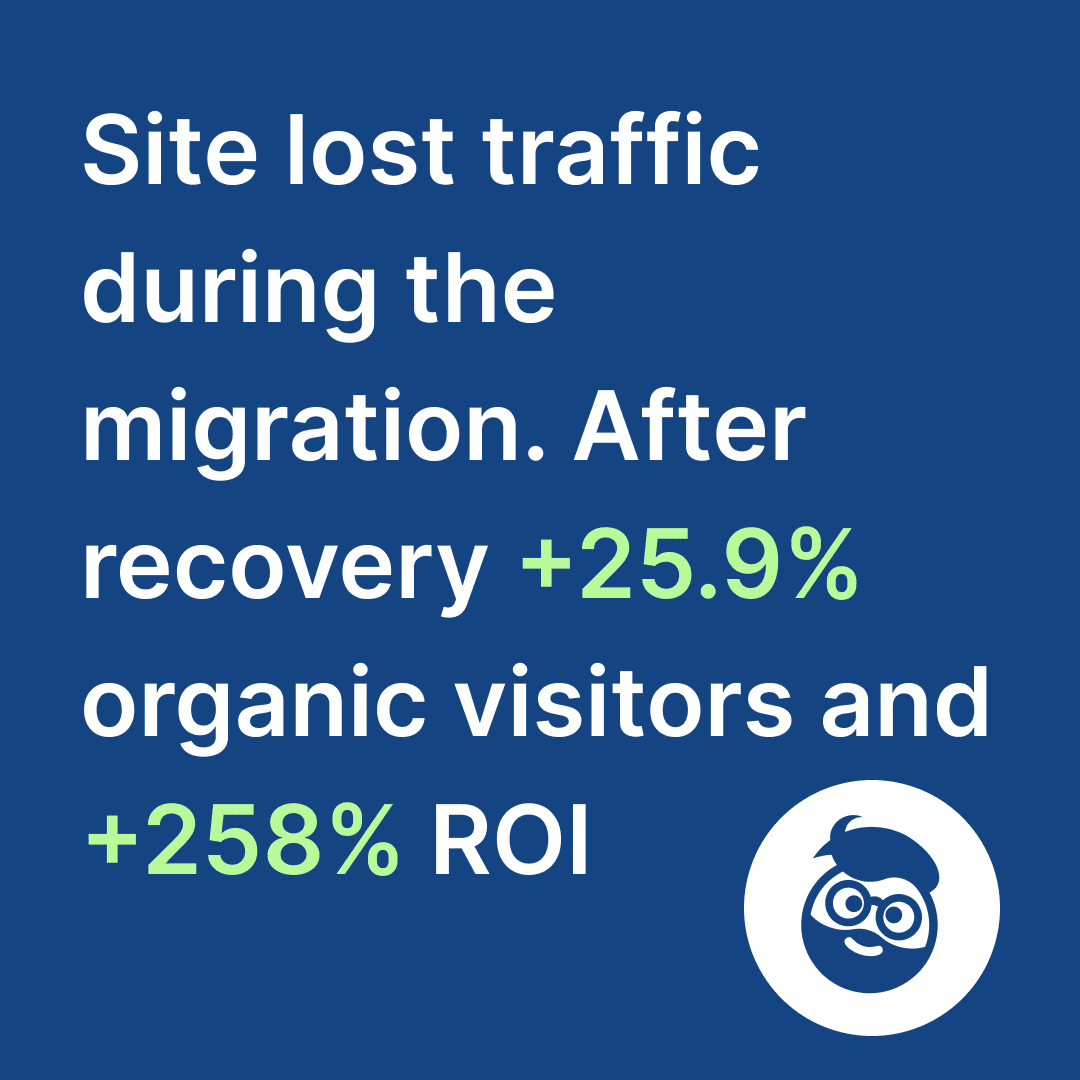
The cost of preventing a migration failure is fixed and known. The cost of recovering from one is variable, compounding, and consistently higher — because recovery requires not just fixing the technical issues but recapturing ranking positions that competitors have consolidated during the months the site spent underperforming.
Tell us your current domain, your target platform or domain, your approximate indexed page count, and your planned migration date. We will confirm the appropriate service tier, scope, and delivery timeline within 24 hours — and begin the pre-migration baseline audit before your development team starts any implementation work.
Our results-driven and data-backed SEO migration services can assist you in improving the rankings of your website and driving more organic traffic to your website.
Get in touch with us today to discover how we can assist you in improving the performance of your website.